
On October 10, 2022, in Klintsy, southwestern Bryansk Oblast, Russia.
It was the barracks of the Russian 488th Motorized Rifle Regiment, a Khrushchev-style five-story barracks building, room 204 on the second floor.
Chen Ge stood by the door, looking at a line of chalk writing on the wall: “We are from Kostroma. We will return.”
The handwriting was sloppy and crooked. The date at the end was March 1, 2022.
Return? The grass on their graves is probably half a meter tall by now!
He pursed his lips and took a fierce bite of the half-smoked sausage in his right hand.
It had an aroma similar to bacon: salty and savory, with a hint of garlic and pepper. The texture was firm and springy, with a meaty, grainy bite. It wasn't greasy, and it was very filling.
There were four old Soviet-style double-decker iron bunk beds in the dormitory, with a long wooden table in the middle. Including him, there were five of them: Ivan, Andrei, Korolenko, and Pushkarev.
Ivan sat on the lower bunk of the iron bed to Chen Ge's left, wiping a PKM machine gun with a gun cloth. He was cleaning it carefully, as if it were going on display tomorrow.
Andrei lay on the upper bunk on the inner side to his left, his left hand pillowing his head while his right hand toyed with a round arm patch.
The patch had a black background and a red circle. In the center was an embroidered white skull with red crosshair lines. Above were the English words ISIS HUNTERS, and below was Arabic script.
This was the exclusive patch of the anti-ISIS special unit formed by Wagner (Wagner Group) in Syria in 2017, also known as the ISIS Hunter patch.
Obviously, they were not Russian soldiers. They were Wagner mercenaries.
Korolenko and Pushkarev sat by the table eating canned food: heated tushenka stewed beef with white bread.
Pushkarev took a bite of bread, turned his head toward Chen Ge, and said anxiously, “Sledgehammer, there are a lot of drones in Bakhmut. They target artillery specifically. Our fire team is in serious danger. I strongly suggest you go ask the captain for more counter-drone equipment.”
Sledgehammer was Chen Ge's code name.
Chen Ge turned and leaned against the wall. “We already have two electromagnetic jammer rifles. If we get more, are we not carrying artillery shells anymore?”
Pushkarev had no reply. He swallowed his bread, wiped his mouth, took a cigarette from the pack, and lit it.
Andrei turned onto his side, waving the newly bought Xiaomi Poco X4 Pro in his hand. “I just asked a friend in Bakhmut. He told me the jammer rifles can only intercept ordinary drones. The Ukrainian army's FPV drones are very hard to defend against. They're small and fast, used in suicide attacks. By the time you hear the buzzing, the drone has already crashed into you. He was hit on the helmet by one yesterday. Fortunately, the warhead didn't explode.”
Korolenko felt a chill creep over his scalp, raised his head, and asked, “Then how do we dodge them?”
“You can't dodge them.”
Andrei shook his head dejectedly. “FPVs go over 100 kilometers per hour. Unless you're Spider-Man with a danger sense, it's hard to dodge them.”
“And Bakhmut is being fought over too fiercely. For the past two months, we've been attacking the Ukrainian outer positions. Both sides dug trenches and blasted each other with artillery. This month we pushed to the outskirts and started urban warfare. You all know how terrifying urban warfare is.”
“My friend's unit went to Bakhmut on September 17. A three-hundred-strong assault team attacked a factory in the eastern suburbs. In ten days, fewer than one hundred were left alive—either dead or maimed. Shelling was useless. The underground passages in Bakhmut are like a spiderweb. Trucks can drive through the main routes, and even tanks can pass. You never know where the Ukrainians will pop out from.”
“The only good news is that winter is coming soon, so the attacks on fortified positions should stop. They won't launch a large-scale offensive until next spring.”
After finishing, Andrei turned over to face the wall and added in a low voice:
“Brothers, get ready. Bakhmut is hell!”
Pushkarev smoked faster, while Korolenko and Ivan remained silent.
The atmosphere in the dormitory became unusually oppressive. No one spoke; each was lost in his own thoughts.
Chen Ge shook his head slightly. This was no good news. The new commander of Russian forces, Surovikin, and Prigozhin had already completed their meat grinder plan: to hold the Ukrainian army in Bakhmut at all costs and deplete its effective forces. The Bakhmut meat grinder battle, hailed as a modern Verdun, was about to begin.
He chewed the sausage in his mouth and looked down at his equipment.
On his lower body, he wore G3 tactical pants and Adidas GSG9.3 tactical boots. On top, he layered a LEAF Naga fleece and a G3 jacket, with an AVS tactical vest, an MRB 2.0 modular craftsman belt, and an AK12 rifle slung across his body.
On the Picatinny rail atop the receiver cover, a 1P87 holographic sight was mounted in line with a 1PN138 side magnifier that folded to the right.
On his head he wore a FAST SF helmet and an AMP headset.
A man should treat himself well. He was quite willing to spend money on himself, so his equipment was rather lavish.
After looking down for a while, he set down his helmet and rifle on a 5.11 Rush 100 tactical backpack beside the wall. He touched the ISIS Hunter patch on his right arm, and his expression turned melancholy.
Suka blyat! Tomorrow I'm going to that meat grinder, Bakhmut. After tiptoeing on thin ice for the past few months, can I still return home in one piece?
What no one knew was that he was a transmigrator who had crossed over in body from the year 2026 into this parallel world.
Before transmigrating, he had been a yellow-robed delivery knight in the Magic City.
On May 20, he delivered flowers, condoms, cakes, and gifts, running from morning till night. It was already midnight when he finished. The last order was a custom character cake with black truffle.
It was a 7,880-yuan cake. He delivered it to an upscale residential compound. The female customer didn't even open the door. She casually said, “You can eat it,” and hung up.
Carrying the cake downstairs, he sat on a bench in the compound and wolfed down that high-end cake—one he had never even seen, let alone bought to eat, on ordinary days.
Guess what? The cake had been spiked, and the drug was very potent. Afraid he might turn into a beast, he rushed red-eyed to the artificial lake in the compound and dove into the water in a not-quite-standard 101A-style posture.
Then he crossed over in body to Deir ez-Zor Province, Syria, on January 24, 2022. He crawled out of the Euphrates River, and before he could recover from his daze, four ISIS terrorists seized him and dragged him back to their stronghold to record a beheading video.
Just as the terrorists raised a machete to chop him apart, an elite squad of Wagner mercenaries appeared as if from nowhere and rescued him safely.
A segment of memories also materialized in his head—memories of his new identity.
They had the same name and surname, the same age—both born in 2001—the same native place, Dali, Yunnan, and the same build and appearance.
Their family circumstances were different. Chen Ge's father, Chen Lang, was a truck driver. In April 2004, drugs were secretly hidden in a sealed compartment in the truck's frame. They were discovered in Guangzhou.
In 2004, the truck had no dashcam, and there was little surveillance. How could he prove his innocence?
In the end, Chen Lang was sentenced to fifteen years in prison. In the second year, he died in prison from a sudden heart attack.
While his father was in prison, his mother remarried and took his younger sister with her that same year, leaving him uncared for. He grew up with his paternal grandparents.
This Chen Ge was definitely an exceptionally talented genius. He had a strong aptitude for languages and taught himself English, Russian, and Spanish in middle and high school. He always ranked first in his grade, had good physical fitness, and even had 3.0 vision. He was clearly a top-tier pilot candidate.
But the label of being the son of a drug dealer completely cut off his future and doomed him never to rise again. From childhood on, he was discriminated against and isolated.
In February 2019, just after his eighteenth birthday, his grandfather and grandmother died one after another. With no ties left, Chen Ge got his passport, contacted a distant relative who ran a restaurant in Moscow, and decided to go abroad to make his way.
Half a month before the gaokao, he went to Kunming to process work visa formalities. Three days after the gaokao ended, he flew to Moscow.
Life in Moscow was quite comfortable. In January 2021, he met an artillery instructor at the Kubinka military amusement park on the outskirts of Moscow, named Oleg.
Oleg was a veteran of the Chechen war and an expert at firing mortars. He took Chen Ge to Kubinka to play with guns and artillery.
He didn't know until he tried; the first attempt was shocking. Chen Ge had excellent physical fitness and eyesight. On his first try with an AK-74, he scored 98 rings out of ten shots. He also possessed an artillery sense beyond ordinary understanding.
It was the kind of artillery sense where he didn't need a sight, didn't calculate formulas, and didn't measure distance. With one look and a grip by feel, he instinctively knew how high to elevate the barrel, how much charge to use, which way to adjust, and could fire accurately as soon as he raised his hand.
The standard Russian 2B24 82mm mortar in his hands was like a sniper rifle: wherever he pointed, he could hit.
Oleg was stunned. He tried teaching Chen Ge a one-handed mortar technique: no bipod or baseplate, left hand steadying the barrel, right hand loading the shell.
Chen Ge learned it immediately. His eyes were a ruler. Within 2.5 kilometers, his hit rate reached an astonishing 95 percent.
Why only 2.5 kilometers? Because the human body could not withstand the enormous recoil of a full charge. The collarbone would suffer a fatigue fracture, and the wrist could dislocate.
Mortar shells had a built-in basic charge tube called the basic charge (No. 0 charge). At the tail, one could fit donut-shaped additional propellant charge packs, numbered 1 to 4. Fit one on, and the range doubled—and so did the recoil.
Oleg tested him. His limit was firing twenty-eight consecutive 82mm mortar shells with two additional propellant charge packs, with a 96 percent hit rate. Oleg looked as if he had seen a ghost, clutched his hair with both hands, and shouted, “Oh God!”
Then this old fellow went to brag to his comrade Mikhail, a mid-level commander at the Wagner Group. Mikhail naturally didn't believe such an absurd person could exist and came to see for himself.
The result was that he was shocked by Chen Ge's extraordinary artillery sense. He invited Chen Ge to join Wagner, offered him a high monthly salary of eighteen thousand US dollars, and promised to assign him bodyguards so he could focus on firing mortars.
Making eighteen thousand dollars a month just for firing guns—how could a poor wretch like Chen Ge resist such temptation?
He joined the Wagner Group on August 12 and signed an eighteen-month contract. After one month of military training, he deployed with Mikhail to Deir ez-Zor Province, Syria, on September 28. His main mission was to help the Assad government eliminate ISIS terrorists.
In the Middle East, where the terrain was flat and open, the climate dry, rainfall and fog rare, and visibility extremely far, Chen Ge's terrifying abilities were immediately revealed.
The 82mm mortar was too heavy and inconvenient for mobility. Chen Ge's exclusive weapon was a Chinese-exported WA126 60mm mortar. He didn't use any bipod or baseplate; he carried a 9.45-kilogram barrel everywhere and ran around.
Against targets within 2.5 kilometers, he almost never missed. Even against moving targets, such as ISIS pickup trucks, his hit rate reached a scalp-numbing 90 percent.
People gave him the nickname Sledgehammer, and his teammates also called him Brother Hammer.
Sledgehammer was Wagner's exclusive code name, though he had taken it relatively early; it became his code name in November 2021.
Before that, someone else inside Wagner had used the code name Sledgehammer, but he had died in action in Africa in 2020.
The origin of the code name was Chen Ge's fondness for European medieval war hammers. Wherever he went, he carried a 1.5-kilogram short-handled war hammer forged from Damascus steel, flat on one end and pointed on the other. It could easily pierce a bulletproof helmet.
After the transmigrated Chen Ge absorbed the original Chen Ge's memories, he found that he was several years younger and had gained the original's language talent, extraordinary eyesight, and artillery sense, yet he was not happy at all. He was so anxious that he wanted to jump back into the Euphrates and transmigrate back.
In a month, the Russia-Ukraine war would break out! The elite Wagner forces deployed abroad would be transferred to fight in Ukraine.
The Russia-Ukraine battlefield was not the Middle Eastern battlefield where noobs pecked at each other. Except for nuclear weapons, everything that could be used would be used; the intensity of war was extremely high.
If this Artillery King went to the Russia-Ukraine battlefield, he would definitely draw concentrated fire from the Ukrainian army: drones, rocket artillery, large-caliber shells, even missiles.
Just thinking about it made his scalp crawl and his hair stand on end. He felt terrible all over.
What kind of fucking hellish start was this?
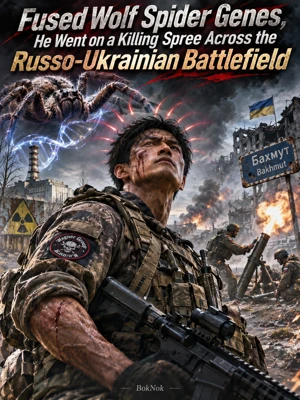
Fused Wolf Spider Genes, He Went on a Killing Spree Across the Russo-Ukrainian Battlefield
Author: Ren Ke He Ya
Chapter 1