
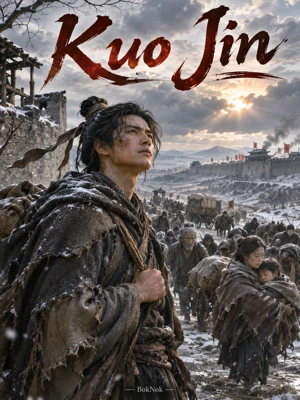
In the fifth year of Yonghe, in the seventh month, it was the very start of early autumn.
On the north bank of the Huai River the summer heat had not yet broken and the crops in the fields were not fully ripe, yet as far as the eye could see, the broad plain was almost everywhere covered in roughly cut stubble. Some of the freshly severed stalks still wept green sap, though they were fated not to last until the next morning, when dew would have laid itself over the fields. The fierce sun and the warm south wind would drink them dry that same day, and they would turn yellow and withered like the stubble around them, with no life left in them at all.
Clearly someone had defied the season and cut the crops early, and this was no isolated case.
On closer thought, though, it was not a hard scene to understand. The age they lived in was thirty years after the gentry crossed south, with the Great Jin clinging to the south and the Jie Zhao established in the north — the so-called age of confrontation between north and south. In such a situation the Huai north lay between the two, and war followed war: raising walled enclosures, abandoned fields, flights from danger, the massacre of a city — all of it common enough. To escape disaster, what was a crop cut early?
All the more so in the fifth year of Yonghe, when there was a better reason than usual. Shi Hu was dead!
Yes, that legendary tyrant of the Jie Zhao had died in the fourth month. His death did not exactly set the whole realm cheering — after all, the House of Zhao held two-thirds of the world, and who in the Huai north would lightly question its rule?
So over the next two months the north boiled over: Jie, Xianbei, Di, Qiang, Han; Shi Zun, Shi Bin, Shi Jian, Shi Min, Zhang Chai, Fu Hong, Yao Yizhong, and a whole crowd of Murongs. Names tumbled over one another, tribes turned upside down, one man arriving as another fell, one dying as another rose... Perhaps the native great clans of Hebei could make out a thread or two in it, but for the great clans of the Huai it was sheer confusion.
It was just then that Chu Pou, Grand Commander over the military affairs of the five provinces of Qing, Yang, Xu, Yan and Yu, the place where the realm's true orthodoxy lay, formally led the imperial army north on the Northern Expedition. He came in person to Pengcheng in Xuzhou and seized Xiakou on the Si, and at once the world shook.
The Huai north, first in line, was thrown into an uproar. The great clans of the Huai, long past bearing the tyranny of the House of Zhao, moved out household by household to join him, and the local common folk, who had always depended on those clans, could only cut their unripe crops and follow along. Amid the turmoil the refugees reaching Pengcheng each day numbered in the thousands.
Liu Acheng, who came from Qiao Commandery, was one of them.
No one knew how old Liu Acheng was this year — perhaps thirteen or fourteen and old for his age, perhaps sixteen or seventeen and slow to grow — either way he had the look of a half-grown lad, yet he had long since bound up his head and dressed himself as an adult. Where he came from no one knew either; he could only be said to be a Qiao man, since everyone had fished him out of an earthen well in Qiao Commandery, and he had walked from there to here with them, and he called himself a Qiao man — though everyone could tell that his accent was neither one thing nor the other.
Even whether this body was called Liu Acheng was uncertain, because he only knew that in his last life he had been Liu Cheng; when he was first pulled out, everyone called out the sound "Acheng," so he took it for granted that he was still Liu Cheng.
And the truth? No one knew the truth. Perhaps Liu was not even his surname!
In any case, it did not do to think too closely about it, and no one dared ask. Later it stopped mattering at all, because they were fleeing for their lives: from Qiao Commandery to Pengcheng, nearly three hundred li on foot in a few days under blazing heat, until people went numb and the column around them dissolved into chaos. By the time they reached the walls of Pengcheng and drew grain from under Grand Commander Chu, among tens of thousands of refugees the transmigrator had lost all trace of the group he had traveled with.
Yes, Liu Acheng was of course a transmigrator.
The transmigration itself was nothing worth telling.
A thirty-three-year-old city white-collar worker about to be squeezed dry by 996 had finally made department head before the death line at thirty-five, then worked up the courage to ignore the pressure to marry and buy a house and go back to his hometown on the Huaibei plain over the May Day holiday. On an afternoon when drizzle could not drive off the summer heat, he went with relatives into a famous local historic site — an underground troop-movement tunnel, very likely built by a late-Tang regional warlord, certified by Song-dynasty men of letters, and repaired with modern cement.
Before long he grew dizzy in the narrow, damp, endless passage and was forced to duck into a side branch marked "Visitors Stop."
There was nothing strange in the branch, and the far end seemed ordinary enough: a small worksite under the rain, workers in hard hats and rubber boots, seemingly digging something, or maybe building something. Their reaction was ordinary too. Seeing that Liu Cheng was clearly unwell, they dropped their tools and came forward to steady him warmly, then led him to a wide, empty stone platform to catch his breath and rest.
Only then did Liu Cheng realize they were building a "historic site." They seemed to have dug a great pit first, then raised carved stone platforms around it, and the place where he was resting was the platform beside the pit.
He understood perfectly well. This was a historic scenic area, after all, and at the time he only felt that these workers were as hard-pressed as he was, still working in the rain — workers had it hard everywhere.
So he rested a while, caught his breath, cleared his head, and decided not to keep standing in the rain. He thanked the people around him and got up. And just then, on the rain-slick stone, his feet went out from under him and, before the eyes of the workers, he toppled backward into the pit, which had already collected a good deal of water.
Only at that point did he notice the characters carved into the stone platform: the word for "well."
So they were not digging a pit. They were digging a well!
That was the transmigrator's last thought before crossing over, because the next moment a crowd of refugees hauled him out of an earthen well, and he had changed bodies.
What followed was simpler still. The Huaixi region had by now returned to the literal meaning of "barren land for a thousand li": every crop in the fields cut early, rumors of war without end. A transmigrator in a short coarse jacket, patched trousers, a ragged headcloth and straw sandals had no room to think at all. He had no choice but to walk with the people around him, living by carrying others' baggage, gleaning what was left in the fields, finding sour fruit by the roadside — and, above all, by the plain fact that green grain would spoil if nobody ate it, and people were willing to hand it out — until he reached Pengcheng in Xuzhou.
Fortunately the Grand Commander everyone talked about really existed, really did take in refugees, and really did hand out grain.
Old grain, at that, mixed with a fair amount of sand, and one sheng in eight skimmed off into a sack. But it could only be called no great problem, because to a transmigrator it was life-saving supplies, solid and real.
He borrowed a clay pot, paying with firewood he had picked up along the way, cooked the grain, swallowed it, tied the millet sack inside his clothes, hugged a tree and slept. When the sun rose the next morning, he could at last listen to the voices around him and think a little. Whose child had died on the road; who had lost a father or mother; who had come to blows with whom; who had run into tigers or wolves — and then, gradually, words like the Great Jin, Shi Hu, the Grand Commander, Murong, the fifth year of Yonghe. Only then did the transmigrator grasp, in a daze, that he had come to the Eastern Jin.
What could he do about it? The era name Yonghe was simply too familiar — familiar as though carved into his bones.
The Orchid Pavilion in Kuaiji, a whole lifetime in a single glance. The Wuyi Lane by the Qinhuai, swallows before the halls of the Wang and the Xie. The Murong founding a state and restoring one. Oh, and Huan Wen's northern expeditions — even the trees are like this, and I who watch them; you are a sight to break my heart. Wang Meng picking lice out of his clothes, Fu Jian's whips that could dam a river, Xie An snapping his wooden clogs. So why had he never heard of this Chu-surnamed Grand Commander, the one who had saved his life and wielded such power?
Grand Commander over the military affairs of five provinces! And the troops did not look few, either. However he thought about it, this was no empty flourish.
In fact it did not take the transmigrator long to work it out. What else could it be? The Grand Commander's Northern Expedition must have ended in utter defeat, and he had become one more "imperial army routed" among the Eastern Jin's countless entries in the histories.
And really — a transmigrator about to become a beggar, who was not worrying about whose pot he would borrow for his next meal, found that thinking about such weighty matters of family and realm was in fact useful. The logic was simple enough: since Grand Commander Chu's expedition was bound to fail, he had better leave Pengcheng quickly, and ideally follow the people crossing the Si and keep going south.
Flee to Jiankang, register a household in the spiritual capital of the Huaixi people across a gulf of sixteen hundred years, and wouldn't he be safe and sound until the Battle of Fei River? And how many years remained until the Battle of Fei River?
Thinking so, he went and looked — you do not know until you look, and once you look you jump. From a good distance away Liu Acheng spotted that there truly were columns trying to cross the Si and go on, and clearly better disciplined at that, with chickens, dogs, cattle and sheep, chests and carts, even simple banners that must have been handed down by the Great Jin government troops. The refugees left on the south bank, by contrast, were a shambles, nearly every one of them with his mind on the next meal.
No good. He had to go at once.
Once it was clear to him, Liu Acheng did not hesitate. He shouldered what few sheng of old millet he had left and headed for the bank of the Si.
Now, Pengcheng sat where the Bian and the Si met, with the city southwest of the fork. Most of the refugees had gathered on the northwest side, and the few who came from Qingzhou were on the east. Going south by crossing the Bian to reach the city walls was out of the question, since the Grand Commander was inside and the Bian was plainly under strict watch, with all traffic forbidden. So the best road was to cross the Si straight to the far bank and then follow the Si south.
In truth there were plenty of pontoon bridges on the Si to move troops, but for a transmigrator with a few sheng of millet, crossing by himself was not possible. The reason was simple: the column before him had already gone over, and there were soldiers at the bridgehead now. He did not dare gamble on whose sons those soldiers were; he had to wait for another reasonably orderly refugee column and slip across with it.
The chance came quickly. That afternoon another column appeared, huge and yet still fairly orderly — able-bodied men front and rear, women and children in the middle, plus carts, chests, chickens, dogs and pack animals. They had not even collected their grain; they went straight onto the pontoon bridge. Liu Acheng did not dare dawdle. He circled back to the rear half of the column, put his head down, and followed.
Across the pontoon bridge he let out a breath and began thinking about what came next.
Unexpectedly, he had barely gone a few dozen paces, still inside the column, when he heard hoofbeats behind him. He turned and saw a short, stocky youth in a coarse cloth robe, bow slung at his side and sword on his back, riding up. Before he even reached him the youth called out: "Who are you? I've never seen you. Why are you sneaking into our native-place column?"
At that, the people around them stopped, and closed in on him.
Liu Acheng knew he had been caught red-handed, and the other was plainly one of those young toughs besides; he was a man alone with a few jin of millet to his name — how could he stiffen his neck? He only copied the manner he had been watching for the past few days, bowed with clasped hands before the horse, and said in the way he had seen in TV dramas, words that felt awkward even to him: "Liu Cheng of Qiao Commandery, displaced a thousand li, alone now with no one. I had no choice but to shelter under your honored district's protection to cross the Si. I am truly grateful."
Hearing that, the stocky youth was instead taken aback. "You are surnamed Liu?"
"Yes."
"From Qiao Commandery?"
"Yes."
"But there is no proper Liu lineage in Qiao Commandery... Isn't the whole Huaixi area our Pengcheng Liu?" The youth went on frowning; he looked genuinely puzzled. "And your accent isn't right either."
Liu Acheng's heart stirred. Before he crossed over, he had read a few of those high-end transmigration web novels, and he had even bought a book or two like Aristocratic Politics of the Eastern Jin, flipped a few pages and left it on his desk for show; he had watched history celebrities flame each other on forums. How could he not know that the Eastern Jin was a world of great clans — or at the very least that you needed a great-clan identity to have any human rights at all?
And from the other's bearing, he was plainly a member of a refugee commander family of the so-called Pengcheng Liu, a proper lower-tier great clan.
In fact, he should have realized it earlier. A refugee column this organized and disciplined must be led by one of those Eastern-Jin-style refugee commanders, not by a great clan proper — how would a great clan proper manage it? If they were not a great clan, how would they have the vision to abandon the main force and strike straight south?
The thought had no sooner arrived than a bold idea welled up. Liu Acheng summoned everything he had learned scraping along in the workplace, dropped all posturing, lowered his head and sighed, then raised it again with a smile. "I won't hide it from you, brother. I am of Pengcheng Liu stock, it's true. But for one thing, my family moved to Qiao Commandery three generations ago and more. For another, when the Jie bandits threw the realm into chaos, my father and grandfather drifted even further north, and only now that the Jie bandit Shi Hu has died did we get the chance to come south — and I lost my family somewhere in the north. As I look now, if I still dared call myself Pengcheng Liu, wouldn't I be disgracing my ancestors? If one day I could go back to Qiao Commandery and make a living there, I would be more than satisfied."
Yes. Liu Acheng had decided to claim the Pengcheng surname.
Unexpectedly, on hearing this the stocky youth neither swung down from his horse to treat him with courtesy nor questioned him further and then lashed out to kill him. He only frowned again. "No wonder... But we share a surname, in the end. What was that saying again? I've forgotten! Anyway, one fewer of nobody is not fewer, one more of anybody is not more — you come along with us. Find a bunch of able-bodied men and stop squeezing in among the women and children!"
With that he rode straight back to the able-bodied men at the rear.
Liu Cheng was caught off balance for a moment, but once he had recovered he could not help a quiet thrill. Alone and with no one to his name, to be taken in by an organized column like this after losing his old one — his odds of survival went up by a great deal. And more than that, the other had not denied his claim to the Pengcheng surname, had he?
No denial meant tacit acceptance!
Did this count as a cheat code for transmigrators?
Thinking so, Liu Cheng naturally bowed again to the stocky youth, who had already turned his horse, and then pushed his way back into the column. Once the women and children had passed, he found a knot of able-bodied men and hurriedly introduced himself and explained his situation.
This column truly was out of the ordinary. Not only was its own organization high, it also stood well with the Great Jin government troops: that night, camped on the east bank of the Si, government soldiers actually came over to talk with them, then counted heads and issued grain — one dou per man, one shi per ten men, as the saying went. When they opened it there was no sand or grit at all, and no skimping into sacks. Only the column's cook came and took half of it off to the center, and what remained was shared out evenly.
And at the evening meal it turned out to be one great communal pot: a bowl and a half for a grown man, one bowl for a woman or child. His worry about grain vanished on the spot.
That was not all. After the meal an elder with a headcloth wrapped around his head — the cook from that day — came to ask Liu Cheng: since he had eaten a bowl and a half, when they set out tomorrow, would he gather firewood or cut grass on the road? If firewood and grass fell short, tomorrow night's meal would be halved; did he accept that? Liu Acheng was not angry at all but delighted, agreed at once, and then, unable to resist, followed this talkative, easy-tongued elder over to his fire and pestered him with questions about where the column had come from.
It was just as Liu Cheng had thought. The reason the column was like this was that it had a mainstay.
Liu Zhi, courtesy name Liangren. In this age people were especially careful about given names, so to his face and behind his back everyone called him only Lord Liu Ren. Lord Liu Ren himself had grave dirt up to his neck and had never held office, but his father, Lord Liu Xi — whose given name no one seemed to know — had properly served a term as Grand Administrator of Yanmen and a term as Grand Administrator of Dai before the Great Jin crossed south, a man of martial prowess and brilliance, and a genuine pillar of the Pengcheng Liu.
Precisely because of that, everyone above and below, the Great Jin government troops included, acknowledged Lord Liu Ren at this time, regarded him as a proper refugee commander, and did not dare slight him.
And the stocky youth he had seen that day was Lord Liu Ren's youngest son. His given name was Liu Jian, but nobody used it; everyone called him Liu Huzi or Liu Ahu. Rough-mannered by nature, fond of bow and horse since he was small, always getting into trouble from a young age, he was now in charge of guarding the column.
Beside him, his two elder brothers were called Liu Sheng and Liu Pei; their ages had not yet reached the point where their given names needed avoiding, so up and down the column people knew only their proper names and never their childhood ones.
"Third Lord Liu, there is something I don't understand," Liu Acheng said. Feeling more at ease, he had remembered his reason for deciding to go south, and now he was curious. "The Jie bandits are dead, and the Grand Commander's Northern Expedition is such a great show — it's bound to succeed, isn't it? And Lord Ren has such a great establishment at Pengcheng, so many people behind him. By your account, seven or eight walled enclosures, several thousand households, over ten thousand people obey him. So why not stay here and make his name, instead of going south?"
"Who knows?" The Liu-surnamed cook whom the transmigrator had latched onto — the one people called Third Lord Liu — was stumped by the question, and only sat by the fire twisting his grimy beard without a word. "Lord Ren must have his own ideas."
Liu Acheng nodded, then flopped down against a mound of earth, leaning on somebody's sheep, and got ready to sleep. He had never expected much useful information out of these country folk, after all; getting this much about the refugee commander family was already remarkable... The road is long. What comes later can be dealt with later.
"People say that when we get south, we'll all be on the white register. The white register pays no taxes and owes no labor service," a bystander who did not share the Liu surname suddenly cut in from behind the sheep. "Stay in the north and we have land, sure, but with war and disorder, floods and droughts and locusts, you can't farm it anyway. Eight bad years out of ten. Better to follow Lord Ren south and open up somewhere else, and see whether we can live."
"My fellow clansman here asked why Lord Ren goes south. He didn't ask why you do," Third Lord Liu shot back on the spot.
The man who had spoken nodded and did not dare say another word. The rest of them by the fire turned to other talk, and from elsewhere around them came the faint sound of snoring.
You could see that in this archaic feudal age, with the uncertainty of a chaotic era on top of it, a shared surname was a natural bond — and, of course, few people would lie about such a thing, which was probably part of the reason too.
A few breaths later, Liu Acheng, lying there muddled and woolgathering, gave a sudden start and nearly sat up. Refugees were on the white register; the white register owed no corvée and no taxes; you could clear land freely? The world held something this good?!
Pitiful — in his last life he had been a Huaixi man too, and after half a lifetime of scraping by he had never managed to put down roots in Jiangsu, Zhejiang and Shanghai. Now he had gone back to feudal times, to a chaotic era people called the darkest age of all, and not only could he register a household outright, he would get exemption and preferential treatment as well. Where in the world was there such a bargain?
But — but if it was true, then... then what was there to say?
Since crossing over, Liu Acheng had kept up a sort of surface cheerfulness. It was not only that he was open by nature and made the best of wherever he landed; it was also that he had weighed things out clearly in his heart. He had fallen to having nothing at all, true, but he had also landed a great bargain — this young body.
A body of only fourteen or fifteen, not handsome, but with thick brows and large eyes and a decent, upright look to it. Scars and calluses, yes, but after a month of watching he had found nothing seriously wrong with it; it could be called sound in every limb.
The body is the capital of revolution, and age is the size of one's position. With an age and a body like this, a man could always keep his imagination running without limit. At the very least, set beside the previous one, drained to a state of permanent sub-health by his boss, it truly gave him a definite sense of being reborn, and the relief that came with it.
And now, on top of that, he had learned that south of the river he would owe no corvée and pay no taxes. Naturally he could imagine a step further.
How did that line go? Having reached the Eastern Jin and the Sixteen Kingdoms, what was the Eastern Jin most famous for? Besides the great clans, the northern expeditions, and the Five Barbarians' upheaval, there were the fortified manors! So the northern expeditions of striking the waters midstream and hair supple as a ring — he would not want those; the aristocratic clans of a cup of wine and a chant, the utmost delight of eye and ear — he would not hope for those. But could he not buck up and work for a fortified manor of his own, and be its manor lord?
Come the day, with good fields and fine ponds, mulberry and bamboo besides, knowing nothing of the Han and heedless of the Wei and Jin, so-called untouched by heaven and earth, unmeasured by sun and moon, free and easy and happy — even becoming his own emperor over ten li.
Wouldn't that be splendid?
What was this?
This was a heaven-dealt winning hand.
The transmigrator by the fire was so stirred up that he did not drift off into a dazed sleep until nearly midnight.