
The twenty-sixth year of the Republic. Nanjing.
The Jiangning County Government Office.
A hard-up young fellow was slogging through a mountain of official files. His name was Zhu Shiqing.
The lad was bright by nature, with a remarkably quick mind. They said that the moment he was born, the sky overhead was bathed in a dazzling light, and everyone present declared that the child was bound to amount to something.
Three years ago he had become a civil servant of the central government, and he'd thought he would soon set his grand ambitions in motion and make something of himself. But little had he expected that, three years on, he was still a mere clerk.
Still, take a step back: making a name for oneself in a chaotic age was always easier than in an age of peace and plenty.
The old four-class order of scholars, farmers, artisans, and merchants had, under the Nationalist Government, been reshuffled into scholars, merchants, farmers, and artisans. And if one insisted on crowning a single "top dog" among them, one need only add the word "military" before the four — making it military, scholars, merchants, farmers, and artisans. That was the social structure of the day.
Nor had Zhu Shiqing come away empty-handed. Over his three years at Jiangning County, both the chief of the Civil Affairs Section and the county magistrate himself had expressed considerable "high expectations" for him.
By Zhu Shiqing's own tally, Magistrate Diao Yuxiu had once spoken a maxim that had greatly inspired him:
"Brother Zhu, once I'm transferred away, this magistrate's seat will sooner or later be yours. Sometimes I just sigh that I'm getting old — the future and the fate of this country still rest on you young men."
Over two years, he had repeated the line twelve times.
Meanwhile, Zhu Shiqing's immediate superior, Section Chief Xu Gang of the Civil Affairs Section, summed up his opinion of Zhu Shiqing in eight characters: peerless and unmatched, a genius of boundless talent.
On the surface it looked like a moon encircled by a crowd of adoring stars, but reality was all too lean. Praise couldn't fill a belly, nor could it serve as a stepping stone on the road to success.
The county's two consecutive rounds of personnel transfers had both been handed out by Xu Gang to the fellows Zhu Shiqing worked alongside in the same section — one was transferred to Shanghai, the other to Jiangsu.
Even so, Xu Gang would still drop by now and then to smooth over Zhu Shiqing's feelings:
"Little Zhu, it's not that I'm one to fawn on the powerful. With your talent, if you stay in Nanjing, who's to say you won't turn into a bigwig in the central government one day? By then, you and I — and even that Old Smoker — will all get to bask in your reflected glory."
At first, Zhu Shiqing didn't deign to fret over such things. In his heart, his start in life was good enough to count as a "Heaven's Hand" opening.
There were two reasons.
First: Jiangning County had not originally fallen under Nanjing's jurisdiction. But in the twenty-third year of the Republic, three townships — Yanziji, Xiaolingwei, and Shangxinhe — were folded into Nanjing's administrative area, and that earned Jiangning's officials a place on Nanjing's official establishment. And that had happened just when Zhu Shiqing passed the exam into the "yamen."
It had to be said: sometimes a life needs a bit of "dog luck." Zhu Shiqing understood full well that in this era, to realize one's ambitions one had to become an official — and a high official at that.
And with nothing more than a single document from the Executive Yuan, he had gone overnight from an official of a local yamen to a civil servant of the capital. Luck like that was rare to come by in a hundred years; it carried the real flavor of a trend-riding child of the age.
If someone were to go further and compile the marvels that had supposedly attended Zhu Shiqing's birth — purple mist rising in the east, a yellow dragon ascending to the heavens, sweet rain falling from the sky — then even Zhu Shiqing himself might start to fantasize about whether, one of these days, the man seated behind the desk in the county office could be him.
Second: there was Zhu Shiqing's master, Sun Beifeng, whom all his acquaintances called "the Old Smoker." He held a post in the city government. He was a lean, wiry man, and one leg dragged a little — from a battlefield wound, so they said. In his idle hours he loved nothing better than to boast and bluster.
Zhu Shiqing's courtesy name was Jiuru, but he did not know who his parents were — only that they had been revolutionaries of the early days. In the first years of the Republic, his parents had handed the young Zhu Shiqing over to Sun Beifeng in Henan, and afterward Sun Beifeng had made his way south, drifting at last to Nanjing.
With the outbreak of the warlord wars, Zhu Shiqing's parents vanished without a trace, and Sun Beifeng took up the role of his adoptive father.
In the blink of an eye, twenty-odd years had passed.
From being sent to a traditional private school in Nanjing as a boy, to now entering the ranks of officialdom, Uncle Sun had been indispensable in helping him along at every step.
On those two counts alone, Zhu Shiqing could persuade himself to keep slaving away at this beast-of-burden of a post.
And what a beast of burden it was?
The Civil Affairs Section was nominally responsible for a great many things — local administration, policing, transportation, sanitation, disaster relief, public works, and clerical affairs — but when it came down to the actual work…
It boiled down to a single word: write.
In truth, the brothers who knew the ropes had already seen through the trick of it. After Jiangning County came under Nanjing's administration, two new sections — the Construction Section and the Education Section — were established, and together with the existing Civil Affairs, Finance, Military, Social Affairs, and General Affairs sections they made up Jiangning County's apparatus of governance.
The work among the sections was not wholly independent; many duties overlapped, clashing directly or indirectly in their functions. Suppose, for example, a band of refugees arrived in the county. In the magistrate's ideal world, the Civil Affairs Section would compile the refugees' information, the Social Affairs Section would request funds from the Finance Section under the relevant relief regulations, and then the god of wealth would hand over the money — and all would be well.
In reality, though, it was more likely to go like this: a band of refugees turned up from outside — destitute, in rags, a great dark sprawling mass pouring into the city. The Civil Affairs Section went and could get no names or origins out of them; the Social Affairs Section went and could not sort out their relief tier; and by the time it reached the Finance Section, it was simple — no matter how the first two fellows rushed about, the man there had just one line: "No money."
And so things got simple. The Civil Affairs Section began to reason that, for something like relieving refugees, whether or not they were registered didn't much matter — just let the Social Affairs Section handle it by the book.
Why would the Social Affairs Section be willing to toil for nothing? Especially when, after tramping all the way out among the refugees, the government could supply neither money nor grain — and who would be left catching all the curses in the end but themselves? Their measly monthly wage wasn't even enough to feed the whole family, so they'd just as soon steer clear of the trouble and not go at all.
But this was, after all, the capital of a nation — the constant flare-up of ugly social incidents was no way to go on. The magistrate kept hollering that he was going to retire, retire, yet he still dreaded the day some high official might show up and strip him of his post in one stroke. If that happened, how would he go on sucking the blood of the local folk?
He scratched his head and mulled it over for the longest while, and at last arrived at a conclusion, which was: write.
Write it well — that was what mattered.
Sometimes, being handy with an article or a report could solve a great many problems. Flowery diction could extol one's achievements; a plaintive pen could win sympathy and support; laying out the stakes could convey one's helplessness; and a high, rousing tone could lift morale.…
And this was the work Zhu Shiqing had been busy with these past few years. Under the tip of his pen, broken bricks and rotted tiles rose into towering pavilions, and cold and hunger gave way to a land where lost valuables lay untouched by the roadside. In Zhu Shiqing's reports, one could say, Jiangning County had already seen every enterprise revived, its residents' happiness index climbing ever higher.
Though Zhu Shiqing was still in the Civil Affairs Section, he'd ended up doing the clerical work for the entire county, so his colleagues simply called him "Secretary Zhu." Zhu Shiqing could only smile wryly at that — at least in name, he'd been "promoted."
Early in the twenty-sixth year of the Republic, the flavor of the New Year had only just worn off.
Colored red-and-gold silk lanterns still hung over the streets and lanes of Nanjing, not yet taken down. At the ends of the alleys, purple-red scraps of firecracker paper had piled up along the tiled eaves. Stoop-backed rickshaw men hauled their carriages in and out, and merchants bound for distant parts were already spurring their horses on their way.
The Nationalist Government compound was busier still. Buicks all but filled the whole government yard, and officials from every quarter, all in Zhongshan suits and clutching documents, came and went without cease, from sunrise to dusk.
As the southwestern gateway to Nanjing, Jiangning County could hardly be absent. Magistrate Diao brought no one at all — only the fair-featured pretty boy, Zhu Shiqing.
After all, the chance to gather for a grand meeting did not come often, and for a local head official to get a shot at facing the high leadership directly — well, one favorable glance and a man might be promoted on the spot. And when it came to who could best package the county's work, why, who but this pretty boy?
Never mind that at the end of last year a great event had shaken the Nationalist Government: the Generalissimo had been seized at Xi'an. That had thrown the whole Nanjing government into no small upheaval. Undercurrents seethed among the factions within; the pro-Japanese and pro-American cliques came swaggering onto the stage; the organizational and personnel arrangements were reshuffled. From what Zhu Shiqing could see, a county secretary who had served five years in Jiangning had, in a flash, been moved up to the Central Second Bureau.
How many improper and irregular transfers had been made in the meantime, and how many cases of them, there was no telling.
At the time, Zhu Shiqing could not help but have an attack of his occupational ailment, and he wrote down his state of mind in his notebook:
"Whenever the winds and clouds of turmoil arise, the departments of government, instead of joining their strength to meet the troubles from without, let base, grubbing men form cliques for private gain and contend for power and profit. Every vital post is filled without asking whether the man is worthy — asking only what the people will say. A system such as this is truly fragile."
Now, back to the main story.
At dusk, the twenty-four-year-old Zhu Shiqing poked his head in and edged his way into the government building.
This was a place of great magic — countless souls longed to earn a bowl of rice here.
He passed along a corridor, and there above the main gate hung the words "The World Belongs to All." Once through that plaque, everyone took their seats in the conference hall.
The theme of this meeting was "the acceptance inspection of defense works in the four regions of Jiangsu, Zhejiang, Shanghai, and Guangdong to be completed within three years." Presiding was Sun Ke, a member of the Nationalist Government's Central Committee.
The hall was crowded with officials great and small. Zhu Shiqing sat in the second seat against the wall. The ministers of the Executive Yuan's various departments sat in a surrounding row, and behind them the chief officials of the relevant provinces, cities, and counties were ranked in order. The meeting had not yet formally begun, and many officials were still whispering to one another.
Defense construction in the four regions was no small matter to the Nationalist Government.
During the meeting, Zhu Shiqing kept his head down, listening to Committee Member Sun's account of the defenses in the four regions of Jiangsu, Zhejiang, Guangdong, and Shanghai. These covered river-defense, coastal-defense, and frontier-fortress works — the allotment of anti-aircraft guns and anti-aircraft machine guns, the reorganization of fortress garrison units, the building of permanent close-combat fortifications for the fortresses, and various obstacles.
Zhu Shiqing still had a fairly vivid memory of this matter. When he'd first started work at Jiangning County, the higher-ups had launched a readiness campaign, the core of which was to build a network of permanent defensive works with Nanjing at its center. Jiangning County had been allotted a share of the task.
Jiangning County was chiefly responsible for constructing fortifications along the line of Fangshan, Niushou Mountain, and the Qinhuai River to the southeast of Nanjing — the city's southeastern bulwark.
As he was taking his notes, Zhu Shiqing used the pause of drawing out his notebook to steal a glance around, and all at once it struck him that everyone looked sallow and yellow-faced — his own Magistrate Diao most of all.
Sweat had already beaded on Magistrate Diao's brow, and his broad, fat rump kept shifting back and forth on the wooden chair; he couldn't hold out a minute before furtively changing his position.
Three years in officialdom had made Zhu Shiqing keenly sensitive — one darkening of his vision, and he knew the matter was finished.
In truth, Jiangning County rarely stirred up trouble. Now and then came some petty graft or minor fuss, nothing that could bear the light of day, with no truly ruinous consequences — generally it could be fudged over and smoothed past.
The misfortune was that trouble had broken out on the single most critical matter.
The Nationalist Government's Fifth Plenary Session of the Third Central Committee was about to convene — a rather weighty moment on the calendar.
Committee Member Sun announced that work teams would be sent down to the various localities to inspect the relevant work, and that any head official found to be handling it poorly would be sent to Nanjing for investigation on the spot.
At these words, the hall fell even more deathly still.
On the way back to Jiangning County, a bright moon hung in the sky and a cold chill crept across the land.
The streets of Nanjing still had vendors bustling about — some shouldering carrying-poles hung with baskets, some pushing little carts, all crying their wontons — while in the distance a few tailor shops glowed with dim yellow lamplight, shadows drifting within.
Seated in the Buick, the two of them looked at each other without a word. Zhu Shiqing silently savored this "high-level meeting," and in the night he felt a strange, reasonless excitement.
And to have become, in '37, a so-called central civil servant of Nanjing — was it truly "dumb luck," or merely a "dog's" lot?…
Beyond the car window, the radiant, resplendent ancient capital of the Six Dynasties lay veiled in the boundless night.
PS: The world of this book is a parallel one. I mean no disrespect to history whatsoever; any resemblance is purely coincidental, and any difference is likewise only normal. Thanks to all you big shots for reading.
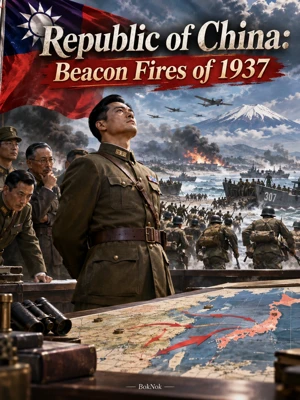
Republic of China: Beacon Fires of 1937
Author: Wei Wu Xiao Feng Zi
Chapter 1