
Dashun. The marshlands of Jianghuai. The market town of Yixing.
Polished bluestone slabs reflected the moonlight like mirrors. Dry leaves came down, piling up nowhere, drifting and turning across the ground.
Wind rolled in off the river that stretched ten thousand li, then streamed away over the open rooftops, slipping through the cracks of doors in fine wisps.
Like weeds stirred by the wind, bent yet standing upright, the deathly silent youth inside the mud-brick house stirred back to a flicker of life.
Hungry!
So hungry!
Liang Qu opened his eyes, his gaze unfocused, aware only of a knife-twisting pain in his stomach. He lay curled into a ball on the bed boards.
Liang Qu. He had been called Liang Qu too? A mother dead in childbirth, a father dead of a chill just a month before—what a standard-issue start. One boat, one room—
No, wait. The boat had been snatched away as well, by Scabby-head Zhang, who'd pushed the boy around for being young... Damn it, that face had been disgusting. A toad turned spirit?
Forcing down his hunger, Liang Qu finished sorting through the jumbled scraps of memory and sat in a daze.
The Jianghuai marshlands fed thousands upon thousands of fishermen—and he had somehow become one of those small fishermen?
Yellowed polluted water, the shriek of sirens, nasal passages burning as if seared by fire, the huge bright patch a powerful flashlight threw across the water.
Not a dream. He really had gone into the water to save someone, and drowned...
Of course. He'd been rushing a manuscript late into the night—where would the strength to rescue anyone have come from? One hard plunge into the water, and he had transmigrated, plain as day.
A pity he'd had no children, or this would have won them bonus points on the college entrance exam for sure—a win at the starting line.
Liang Qu lay sprawled on the bed, feeling a fatigue rise from the deepest bottom of his heart, as if the twenty-odd years behind him, like the traces of falling autumn leaves, had never existed at all.
Nothing gained, nothing loved, nothing achieved.
Life truly was meaningless.
His stomach growled.
All right—so it had some meaning after all. He was too damn hungry.
Hunger drove Liang Qu to survive. Transmigration had cured his severely nearsighted eyes, as if a film of mist had been wiped away; his surroundings stood out uncommonly clear. But one look around the room: a bed, a stove, an empty vat.
The dead boy's memories attacked again.
"Get lost! Get lost, you little jinx! Still coming to borrow grain? My own Liuzi doesn't eat his fill."
"You know as well as I do, the autumn tax is almost—"
No. Water first.
The stomach pain kept jabbing at his brain. Liang Qu pulled a wry face, slid down off the bed boards, and hauled himself up along the yellow-earth wall, swaying out of the house—but a few steps left him gasping, and he had to sit down on the threshold and rest.
This body is far too weak.
Cold sweat beaded on Liang Qu's head; his palms lacked the strength even to open. He could scarcely believe how feeble the body was. Surely he wasn't going to die a second time right after arriving?
Cold fear closed around his heart like a giant hand.
All that talk of how dying once teaches you not to fear death—all lies. The fear of death is written into a person's genes.
Clackety-clack.
Cart wheels rolled over the bluestone bricks with their own distinctive sound.
People!
His heart nearly leapt out of his throat.
"Never mind him. Go around."
"Bad luck. Don't let a starving ghost latch onto you."
He couldn't make out what the carters were muttering—only the wheels growing distant.
The words reached his lips and were swallowed back down. The street's darkness was endless. Liang Qu felt a chill rise from the bottom of his heart; the blood through his whole body was slowly going cold.
He wanted to find a well, but he no longer had the strength to move a single step.
"Ah Shui? Why are you sitting out here?"
Ah Shui? Who—me?
He turned his head. A swarthy, weathered man stood right beside him, and the name bolted out of Liang Qu's mouth: "Uncle Chen?"
Memory told him the man was called Chen Qingjiang, his neighbor.
Of course. He himself was Ah Shui.
The same name across two lives—since the qu in Liang Qu was a character of water, the locals simply called him Ah Shui.
Liang Qu steadied his breath. That little scene had drained whatever urge he'd had to beg anyone for anything. He said with a rueful smile, "Walked myself tired. Sitting down for a rest. And you, Uncle Chen?"
"Just got back from selling fish in town."
"Town?"
"That's right. Fish are fat these days and sell easily—of course I go to town. Selling through the fish brokers just means eating a loss, and I never rented their boat; I'll sell to whoever I please. But what about you? Sitting at your door out of nowhere—aren't you afraid of catching a chill?"
Chen Qingjiang leaned closer out of curiosity—and started back, alarmed, at that wasted, withered look.
How had it come to this?
Even in his dread he suddenly remembered that Liang Qu had lost his father; the house must have run out of grain long ago. His hand went instinctively toward his breast—then he hesitated.
In there was one meat shaobing, a baked flatbread. He had walked a dozen-odd li to carry his catch into the city and earn eight extra wen, and that bread was what he'd bought with them, so his youngest son, who'd been crying and fussing terribly, could taste something new.
It was already dark, and the bread, held warm against his chest, hadn't even cooled through—and now, in a blink, it was going to someone else. To say it didn't pain him would be a lie.
"Daddy, why doesn't Brother Shui come play with me anymore?"
"Because Brother Shui's daddy has gone. He doesn't have time to play with you."
"Why did he go?"
Chen Qingjiang had no answer.
Chen Shun was Chen Qingjiang's eldest son, just six years old, and loved nothing more than running to find Liang Qu to play.
Chen Qingjiang thought of how, when he himself was ten-odd, Liang Qu had been about as old as his own son was now, and had liked coming to find him to play. Dimly, in a daze, the two figures seemed to overlap.
Ahh.
Chen Qingjiang drew the shaobing from his breast and peeled open the oil-paper wrapping.
"Here, Ah Shui. Eat."
"Uncle Chen! This—"
Liang Qu's Adam's apple bobbed. He had thought he faced the road's end again—and then, in a blink, a way out appeared. He wanted to say something, but the rich aroma was simply too tempting; his trembling hands reached out and took it almost of their own accord.
Blood welled from his cracked lips; the taste of rust mixed with the fragrance of wheat, oil, and meat fat as he crammed the whole thing into his mouth.
What little saliva he had left was squeezed out, moistening the bread as it slid down into his stomach. A few swallows, and strength seeped back into him; Liang Qu hurried to give thanks.
"Eat up. Then go straight home—no more hanging about the doorway."
"Mm."
Chen Qingjiang brushed off his trouser legs and rose to leave, though his heart felt heavier still.
If it was like this now, how much harder would winter be? Maybe he ought to talk it over with A-Di and spare a few jin of grain for the boy? But Erbao had only just been ill and seen by a doctor—could they really spare any?
Straw sandals rasped along the dirt road, farther and farther away.
"Whew—so good!"
Liang Qu swallowed the last bite of bread, watching Chen Qingjiang's retreating back—and the words he might have called out never came.
These last years had been peaceful, without disaster: one dan of rice cost about a thousand wen.
Uncle Chen's household had five mouths—an elder, two children, a wife, and himself. One season took at least four dan of rice, which worked out to thirty-three wen a day just to keep them in grain.
Scooping in spring, catching in autumn, tending fish in summer, fighting it out in winter—in autumn, with the grass lush and the fish fat, Uncle Chen made roughly eighty wen a day. It sounded passable; in truth it fell far short.
Cloth, salt, greens—everything cost money. The fishing tax weighed heavier than the farm tax, and there were fees of every sort besides. Never mind anything farther off: the wharf alone charged two wen a day just to moor a boat, four wen in flood season. Come winter, income fell away sharply—and if sickness struck in the middle of it...
That single meat shaobing must have been squeezed out with great difficulty for his own child—and now it had become the kindness that saved Liang Qu's life.
Truly: it is hardship that reveals the truest hearts.
The night sky blazed with stars, glittering bright.
When had his smog-choked little city ever held a night like this? And that was precisely what reminded him, every moment of every day—this was an entirely different world.
Liang Qu leaned against the wall as loneliness surged over him like a tide. He knew nothing of fishing. He had no source of livelihood at all.
He couldn't work out how he was to live—how could he have the nerve to cry out fine words about repaying such kindness?
As for turning modern know-how into money... that, too, was hard.
One rough glance down the empty street: many of the houses had stepped horse-head gables, the classic style with walls built higher than the eaves.
That meant the era's productive power had reached a certain level—enough for brick-and-stone construction to displace the old rammed-earth building, so that eaves no longer needed to jut out to shelter the walls from rain, until, to keep fire from spreading from house to house, the walls rose above the eaves as fire-sealing gables.
For brick-and-stone building to have spread this wide, Dashun's productive power had to be at least equal to the Ming and Qing of his former world.
The body's original owner had been bottom of the bottom rung, seldom seeing anything good—but Liang Qu knew that white sugar, refined salt, horseshoes, steelmaking, soap—none of it had anything to do with him now.
Besides, this world was no simple place. Memory held a fierce man in the neighboring town who could punch through a slab of granite as tall as a man—no ordinary human.
But even with connections, it would have been no use.
Why had men in the old days prized sons so? The stolen boat said it all: without a strong laborer in the family, people really could bully you to death.
If even a boat drew that kind of trouble, what would saved-up cash have drawn?
For an orphan in the old days, staying alive was hard as climbing to the sky. If no one sold him off, he simply waited for death.
Damn it all—why a fisherman start? A fisherman with his boat stolen, no less! Even a farmer would have been better!
Hard, hard, hard!
And at that very moment, a vast, rolling breath of qi abruptly tore through Liang Qu's mind. Countless memories churned—like swallowing a whole packet of mint candies in high summer, a coolness clean through him.
Whoa, whoa, whoa—what the hell is this?
Liang Qu didn't know what to do with himself.
Thankfully the feeling came fast and went fast too. As the strangeness in his mind gradually stilled, it was like clouds and mist scattering to reveal the blue sky once more.
A great cauldron of strange design surfaced in his sea of consciousness, endless arcane patterns interweaving across it, leaving him gaping.
Its name—the Marsh Cauldron!
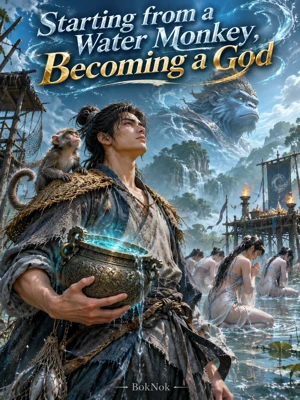
Starting from a Water Monkey, Becoming a God
Author: Carapace Ant
Chapter 1