
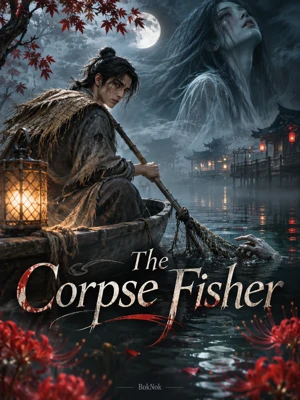
“Little rascals, come and eat, woo-lee woo-lee woo-lee~”
Cui Guiying, an apron tied around her waist, held a bowl in her left hand and a ladle in her right, calling out as she rapped the rim of the porridge vat.
Li Weihan, sitting nearby stuffing tobacco into his water pipe (hukah), kicked the woman on her big backside and cursed grumpily:
“Got water in your brain? You calling piglets?”
Cui Guiying shot her man a glare, set a stack of bowls down heavily before him, and spat:
“Bah! Pigs aren't half as rowdy as they are, and they can't eat anywhere near as much!”
At her call, a pack of children came running in from outside — seven boys and four girls, the oldest sixteen, the youngest barely three.
Li Weihan and his wife had raised four sons and one daughter. Once the children grew up they'd split into their own households, and on ordinary days only the eldest son's family, who lived close by, left their pair of three-year-old twins here to be raised.
But once the summer break came — whether for convenience or because they figured that missing out on the free meals at their parents' place would be a loss, no one could say — anyway, everyone sent their own children over.
Once you took in the eldest's, you couldn't very well refuse the rest, and just like that the house turned into something like a schoolhouse.
Before the couple had time to savor the sweetness of a house full of children and grandchildren, the rice jar was visibly about to be scraped to the bottom.
The old saying goes that half-grown kids are old enough to eat a father into ruin — and counting the girls, all of them were at the growing age, monstrous eaters, each belly a bottomless pit. When Cui Guiying's family sat down to eat, the staple had to be served up from a vat, and one vat wasn't even enough; another pot was kept warm on the stove.
The couple may long since have had a whole brood of grandchildren, but they weren't actually that old. And by the current rural custom, unless you were sick in bed and had lost the ability to work, then so long as you still had the strength to go out to the fields, no matter how old you were, you had no right to the food provided by the children in support of their parents.
“Don't grab, don't grab! Are you all starving ghosts reborn? Line up for me, every one of you!”
The children came holding out their bowls, and Cui Guiying ladled out the porridge.
The last to come over was a ten-year-old boy in denim overalls and fashionable sandals, with fair, tender skin and a shy look on his face.
Beside his brothers and sisters — filthy from play, noses running — he looked rather out of place.
“Xiaoyuan Hou, come, I'll set yours down here for you to eat.”
“Thank you, Grandma.”
Cui Guiying smiled and stroked the boy's head. He was the only grandson-from-a-daughter among this whole crowd of blood grandchildren — though now he no longer counted as one.
The boy's name was Li Zhuiyuan. His mother was Cui Guiying's youngest daughter, the first university student Siyuan Village had ever produced.
The youngest daughter had tested into a university in the capital and, after graduating, stayed in the city to work. She'd found her own man, too, and before marrying had brought him home once — a soft-skinned, mild-mannered city fellow.
She couldn't quite recall his looks anymore, because that day she and her husband had been so stiff and reserved before their son-in-law that they'd been too embarrassed to look at him closely.
Later the daughter got pregnant and bore a son. The road was long and her work busy, so she never came back home. But ever since she'd graduated and started working, she had never once stopped sending money to her parents each month.
The money she'd sent before her marriage, Li Weihan and his wife had saved up every bit; when their four sons took wives, they'd gritted their teeth and held firm, never touching a cent of it. When the daughter brought her man home that time, Li Weihan pushed back the betrothal gift the son-in-law held out, and returned it along with the money the daughter had sent.
They'd wanted to be a bit prouder still and add something extra from the household, but the four sons had married first, and however hard the couple tightened their belts, they simply couldn't squeeze out a drop more.
This had always left the couple feeling guilty: handing the daughter's own money back to the daughter meant that when they'd married her off, the parents had put up nothing at all. A real loss of face.
As for the money the daughter sent every month after her marriage, the couple saved that too. Their sons, egged on by their own wives, came around with all sorts of excuses hoping to get their hands on that money, and Li Weihan cursed every one of them off, jabbing a finger at their noses.
Half a month ago, the daughter had entrusted a man in military uniform to bring her son over, along with a letter and a sum of money. The letter said she had divorced, that there had recently been changes at her work, and that she could only leave her son in her parents' care for a while.
The letter also said that after the divorce she'd changed the child's surname to follow her own, and just like that this grandson-from-a-daughter had become a full grandson.
After coming to the countryside, Li Zhuiyuan had shown not the slightest discomfort; on the contrary, he'd quickly fit right in, running all over the village from one end to the other with his several brothers, having the time of his life.
This meal's staple was sweet potato porridge — sweet to the taste but not filling, quick to digest. Even after downing several big bowls until the belly bulged round, a romp outside for a short while and hunger came right back.
And sweet potato porridge and sweet potato strips, eaten too much and too long, really could damage the stomach — at the mere sight of them, even when not hungry, the stomach began to well up with sour juices.
Li Zhuiyuan, though, wasn't sick of it. He quite enjoyed this “big canteen” feeling, and the various pickles and salted bean paste Cui Guiying made were much to his liking.
“Grandma, why aren't we going to Big Beard's for the feast today?”
The one who spoke was the second uncle's boy, whose nickname was Huzi, nine years old this year.
Cui Guiying rapped Huzi's head with the blunt end of her chopsticks and scolded, “You little devil — that feast's only held because their old mother passed on. You want them holding a feast every day?”
Huzi, clutching his head, said, “Why can't they? Wouldn't it be great if they did it every day?”
“What kind of crap is that out of your mouth, you little devil? Even if their family wanted to hold one, where would they find enough people lining up to die every single day?”
“Smack!” Li Weihan brought his chopsticks down hard on the table and cursed, “What sort of nonsense is that to talk to a child, you grown woman?”
Cui Guiying realized she'd misspoken too, but instead of snapping back at her man, she scooped out a lump of salted bean paste — the paste was mixed with crushed peanuts and a few bits of diced meat, and that very spoonful held some — and dropped it into Li Zhuiyuan's porridge bowl beside her.
Li Zhuiyuan stirred it a few times with his chopsticks; the color of the paste spread out, and tender white bits of meat floated up over the porridge.
The children were sharp-eyed, and above all insistent that no one should get more than another. Huzi at once piped up, “Grandma, I want meat too — the kind in Yuanzi-ge's bowl!”
“Grandma, me too.”
“Me too.”
The other children joined in the clamor.
“Shoo, shoo!” Cui Guiying scolded them crossly. “The little ones don't know any better and kick up a racket — fine. But Pan Hou, Lei Hou, Ying Hou, you older ones are supposed to be the elder brothers and sisters, so what are you joining the fuss for? All of you, show some sense! Everything eaten here today was bought with the money Xiaoyuan Hou's mother gave. Your own fathers and mothers haven't handed your grandma a single grain of rice, and you've still got the nerve to fight him for his food?”
Panzi, Leizi, and Yingzi lowered their heads in embarrassment, while the younger ones just glanced at each other, laughed, and let the matter slide.
It wasn't that Grandma had never hinted at it — they'd relayed it home, too — but their parents had all instructed them to play dumb.
Just then Shitou, the third son's boy, eight this year, asked, “Is that Little Oriole still around?”
Cui Guiying asked, “Who's Little Oriole?”
Huzi answered, “Grandma, Little Oriole is the one who was singing and dancing at Big Beard's yesterday. She sang so beautifully, and she danced so well.”
“Is that so.” Cui Guiying had spent all of yesterday helping wash dishes in their back kitchen, so busy her feet never touched the ground; she'd had no spare time after the meal to go watch the funeral performance troupe put on its show out front.
Her man Li Weihan hadn't gone either. He'd claimed he was taking the boat out, but really he'd stayed home, too embarrassed to show his face; after all, he'd already sent Panzi and Leizi along with Yuanzi, Huzi, and Shitou — five children — to eat at the feast, and if he, a grown man, went too, he'd look unseemly for it.
The five children hadn't just eaten their own fill — they'd carried off a good deal besides, especially those hearty dishes portioned out per head at the table. Following his brothers' lead, Li Zhuiyuan tore off a piece of the red plastic sheet spread over the table before him and used it to wrap up food.
Back home, they'd hand it out to the younger brothers and sisters who hadn't gotten to go, and watching the little ones eat, they felt like generals returning from a victorious campaign.
Leizi said, “Her singing really is lovely, and she's pretty too. She had us all call her Little Oriole.”
Panzi nodded. “She's really nice. She's pretty, her clothes are pretty, and when I grow up I want to marry someone like her.”
Cui Guiying bent down and asked Li Zhuiyuan beside her, “Xiaoyuan Hou, is that right?”
“Mm.” Li Zhuiyuan set down his chopsticks and nodded. “Pretty.”
A rural funeral performance troupe was expected to be all-purpose — dignified enough for the solemn rites, and lively enough for the crowd.
For the ceremonies they could don Taoist robes or Buddhist cassocks to chant sutras and work the rituals, looking ethereal and dignified; and after the grand midday feast they still had to put on a variety show — singing, dancing, acrobatics, magic, whatever they could muster, all of it had to go on.
For a well-off family fond of putting on airs, they might even hire a certain troupe for an evening show — though before that kind of performance began, the grown-ups would shoo the children home to bed.
Little Oriole's surname was Xiao; her real name was Xiao Huangying, and “Little Oriole” was her stage name. She was in fact not so young — in her thirties, and divorced.
In truth, her singing and dancing were no more than half-baked, but she knew how to dress, and wore bold, fashionable clothes — a tight black qipao slit high along the side, baring a broad stretch of white leg — and with her warm, lively way of working the crowd besides...
To describe her, the village women reached for the phrase that was at once their cruelest curse and the highest praise they knew: “seductress.”
These days few households in the village owned a television; people often hauled their stools over to crowd in for a look and still couldn't squeeze into the room. So in a countryside where the winds of fashion had not yet blown in on any large scale, Little Oriole's “allure” left the village girls and young wives all around her utterly outclassed.
She hadn't just led the men by the nose — even the half-grown boys were hooked and utterly smitten.
Just then a figure appeared in the doorway of the main room. It was the neighbor Zhao Simei, who'd been a “sister” to Cui Guiying for many a year. Back when they'd had fewer children at home, whenever they were free the two loved to sit out on the flat ground and gossip.
“Eaten yet?” Cui Guiying asked. “Come — I'll get you a pair of chopsticks.”
Zhao Simei quickly waved her hands and laughed. “Oh my, even if I were to scrounge a meal somewhere, I'd be too embarrassed to come to yours. Just look at you — you're all down to gruel here.”
“This porridge is easy on the stomach; I just love it. Come on, I'll ladle you a bowl. However low the rice jar gets, how could I ever be short a bite for you?”
“Enough, enough — I've already eaten. Hey, did you know? Just now the head of the funeral performance troupe took his people to Big Beard's and made a scene. They say things got smashed and it nearly came to blows.”
Hearing this, Cui Guiying at once picked up her bowl and chopsticks and stood, shoveling porridge into her mouth as she edged toward the doorway. “What happened? Big Beard's family hadn't settled their bill?”
“It's not about the performance fee — it's that someone's gone missing from the troupe.”
“What — someone's missing?” Cui Guiying sucked her chopsticks clean. “Who's missing?”
“A woman — the one always shaking her rump about. The way she was wagging that backside of hers yesterday, I swear her asshole was about to show.”
“Little Oriole?” Panzi asked.
The other children all pricked up their ears.
“Looks like it's her, that hussy.” Zhao Simei was thoroughly gleeful.
“So how did she go missing? Have they found her?” Cui Guiying asked.
“They say someone saw that hussy from the troupe slip into the little woods by the river with Big Beard's youngest son last night. After that she never came back to the troupe, so that's why they've come knocking for her.”
“And Big Beard's boy?”
“Oh, he's at home, all right, but he says he doesn't know anything, that it never happened. But plenty of folks in the village saw it — it was him and that hussy who went into the woods.”
“Then where is she?”
“Who knows? Gone. The troupe leader came this time to demand her back, but Big Beard's family swears up and down they never laid eyes on her, and claims the hussy kicked up her heels and ran off on her own.”
“So what happens now?”
“Big Beard's family paid the troupe leader a sum of money — not a small one, either.”
Cui Guiying promptly slapped Zhao Simei's arm several times and raised her brows. “There's something to it!”
Zhao Simei slapped her arm right back and lifted her chin. “You bet there is!”
Big Beard had once served as deputy head of the grain station in town — a fat post if ever there was one. And though he was retired now, apart from his youngest son who idled about, his other sons all held jobs in town, so that in this village even the village chief's family couldn't match his household's clout.
So the fact that Big Beard was willing to pay to smooth things over meant there simply had to be something fishy in it!
“So after getting the money, the troupe leader just left?”
“Left.”
“And the woman? They're not looking for her anymore?”
“Look for her, my foot — the troupe's already loaded up their gear and gone off in a truck to their next booking.”
“Aiya.” Cui Guiying shook her head. “I just hope nothing bad has happened.”
“Who can say.”
“People... you just never know.”
“Sure don't.”
Hearing this, Huzi and Shitou suddenly burst into tears:
“Boo-hoo-hoo! Little Oriole, Little Oriole!”
“My Little Oriole's gone, my Little Oriole's gone, boo-hoo!”
Seeing this, Zhao Simei nearly laughed a snot bubble out of her nose. She pointed. “See that? Those two grandsons of yours are a stubborn pair when it comes to matters of the heart.”
Cui Guiying rolled her eyes at her and said, “Don't you have a granddaughter? Match one of them up, then.”
“Ha.” Zhao Simei gave a snort and jabbed a finger at Li Zhuiyuan. “I wouldn't say no to us becoming in-laws, but it'd have to be a match with your Xiaoyuan Hou here — so my Xiaojuan Hou can go along to the capital and live in clover.”
“Shoo, shoo — stop dreaming your pretty dreams.”
Li Weihan had already finished eating. He had no interest in the women's gossip, and it wasn't his place to cut in, so he just quietly picked up his water pipe and opened the matchbox — but it was empty.
Li Zhuiyuan set down his chopsticks and ran to the ledge behind the stove to fetch Li Weihan a box of matches.
Li Weihan didn't take them; instead he moved the bowl of his pipe over in front of Li Zhuiyuan.
Smiling, Li Zhuiyuan drew out a match — scratch, scratch, scratch — and finally managed to strike a flame, then hurriedly cupped it with his other hand and lowered the match to the pipe bowl.
Li Weihan puffed several times until the smoke came, satisfied, all smiles.
Back then, his own daughter had loved lighting his pipe for him, too, and had said that when she grew up she'd buy him packaged cigarettes to smoke.
“Whew.”
Li Zhuiyuan blew out the match, dropped it on the ground, and stamped it out several times under his shoe.
Panzi spoke up. “Grandpa, can we take the boat out this afternoon and pick some lotus pods?”
Li Weihan glanced at the plain fare on the table, nodded, and said, “Bring Leizi along. Take the net — see if we can catch a few fish for your grandma to make a soup.”
Hearing this, Huzi and Shitou promptly forgot all about Little Oriole and shouted, “Grandpa, I want to go too, I want to go too!”
The rest of the little ones joined in shouting as well, afraid some fun would pass them by.
Li Weihan looked around sternly and said, “I'm telling you all — there are water monkeys in this river. They drag people under to drown them and make them their substitute ghosts, so that the water monkey itself can go and be reborn.”
At once the children were frightened and didn't dare make a sound.
Shitou, somewhat unwilling to accept it, asked, “How come the older brothers get to go?”
Panzi and Leizi, being older and more sensible, played along to help Grandpa scare the younger ones:
“Big brother's strong — the water monkey can't drag me down.”
“I swim well — the water monkey can't catch me.”
Li Zhuiyuan wasn't scared; he wanted to go too, but was too bashful to speak up, so he could only lower his head and fidget with his little hands, now and then stealing a peek at Grandpa.
Li Weihan said, “Xiaoyuan Hou goes too.”
Huzi immediately protested indignantly, “That's not fair — Yuanzi-ge's only one year older than me.”
Shitou chimed in, “Right — Yuan-ge's not even as strong as me. How's he going to fight the water monkeys?”
Li Weihan slowly exhaled a ring of smoke and gave a perfectly reasonable excuse that even the children found convincing:
“Xiaoyuan Hou's just come back from outside — our local water monkeys don't know him.”
…
The houses in the village were mostly built close to the water, with the front door facing the road and the back door facing the river.
To wash vegetables or clothes, you only had to carry your things out the back door and down a few grey-brick steps to reach the riverbank.
Thrifty households often set a net along the stretch of river by their own home and raised ducks and geese inside the netted enclosure.
The Old Li family's boat was tied to the persimmon tree by the back door. Li Weihan untied the rope, climbed aboard first, and steadied the boat with a bamboo pole.
Panzi hugging the fishing rods and Leizi cradling the net, they jumped aboard one after the other.
Li Zhuiyuan, a small bamboo back basket on his back, was helped aboard by Li Weihan reaching out a hand.
“Everyone sit tight — off we go!”
As the bamboo pole against the water seemed to lengthen and shorten with each push, the boat began to move.
Panzi and Leizi were long used to it and both lay sprawled lazily in the boat, while Li Zhuiyuan sat bolt upright and proper, watching the water plants drift by on the river and the dragonflies dart over it.
“Here, Yuanzi.” Panzi handed over a small handful of roasted beans.
He was the eldest son's boy, and his home was close by, so he'd steal time to go home now and then and grab a few snacks. But his mother had warned him these things had to be hidden away to eat himself, and mustn't be handed out.
By contrast, Li Zhuiyuan's mother — when she'd entrusted the man in military uniform to bring Li Zhuiyuan over, she'd also sent along a big bag of snacks: biscuits, pork floss, canned fruit, and the like. And the day before yesterday she'd mailed another big package. Cui Guiying had locked them all in the cabinet and doled them out to all the children in fixed daily portions.
“Thank you, Panzi-ge.”
Li Zhuiyuan took them and popped one into his mouth. The bean was called “Quan beans” hereabouts — broad beans, really. Pan-fried in the shell with a bit of spice and some salt, they were fragrant to chew.
But Li Zhuiyuan didn't much care for them — too hard, hard to bite, easy to chip a tooth on.
So while his two brothers kept going “crunch, crunch” with their mouths, Li Zhuiyuan just held one in his mouth and sucked at it like a piece of candy.
“‘Come one-jump is a thousand-thousand yo-ge, driftin' out along the road; come one-jump is a thousand-thousand yo-ge, gonna shine real bright tonight.’”
Panzi started to sing.
“You're singing it wrong,” Leizi laughed. “That's not how it goes.”
Panzi said disdainfully, “Hmph, you think you can sing it? Go on, you sing it, then!”
Leizi worked his lips a few times and scratched his head. “I only remember the tune.”
Li Weihan, poling the boat, asked, “What on earth are you singing? I can't make sense of it.”
Panzi answered, “Grandpa, it's what Little Oriole was singing yesterday. It's called Yue opera.”
“Yue opera?” Li Weihan was a little surprised. “What you just sang was Yue opera?”
Leizi said, “No, Grandpa — it's Cantonese opera, from Guangdong and Hong Kong way.”
“Oh, I see. Then sing it properly for Grandpa to hear.”
Leizi said, “Panzi can't sing it at all — he can't even remember the words. He's nowhere near Little Oriole from yesterday.”
In truth, Little Oriole's singing wasn't very accurate either, but for the mainland these days it made little difference whether it was accurate or not — nobody understood it anyway. All that mattered was the confident air she put into it.
Panzi pointed at Li Zhuiyuan and said, “Yesterday when Little Oriole was singing, I saw Yuanzi sing along. He can sing it.”
Li Weihan said, “Xiaoyuan Hou, sing it for Grandpa.”
Li Zhuiyuan said, embarrassed, “I only know a little bit of it.”
“Sing it, sing it,” Leizi urged. “Forget Cantonese opera — Yuanzi can even sing songs in English.”
Li Zhuiyuan had no choice but to sing:
“‘Though a thousand thousand songs may come the morrow, drift far off along my road; though a thousand thousand stars may come the night, they'll never shine as bright as tonight's moon.’
That's all I know. Mom loves this song — she plays it a lot at home.”
Leizi looked at Panzi as if to provoke him. “Hear that? Your words were wrong.”
Panzi rolled his eyes hard at Leizi.
The brothers chattered on the whole way, and the boat at last poled out onto a wider stretch of river.
Panzi went to help Grandpa with the pole. Li Weihan began looking for a good spot as he sorted out the net, and Leizi set up the fishing rod.
Li Zhuiyuan wasn't given any task; he kept his little bamboo back basket on and sat there bolt upright, watching Grandpa and his brothers busy about their work one moment, and the water plants and the frogs hopping about on the river the next.
As he watched, Li Zhuiyuan leaned forward, puzzled.
Li Weihan had been keeping an eye on this “grandson-from-a-daughter” all along, and seeing him like that, promptly warned, “Xiaoyuan Hou, sit back toward the middle — don't fall in!”
Li Zhuiyuan pointed at the water ahead and asked, “Grandpa, ge — there's a clump of black water weed over there.”
“Where?” Leizi looked in the direction Li Zhuiyuan was pointing. “Huh — it really is. Black.”
“Where, where?” Panzi was helping pole the boat at the stern and couldn't see clearly, so he took it on himself to pole the boat over toward that spot.
At first Li Weihan paid it no mind — he was busy working a knot loose in the net. But when he heard Li Zhuiyuan and Leizi still chattering on about it, he raised his head and glanced over. At that single glance, his eyes went wide and locked on.
That clump of black — fine yet spreading, scattered yet not parting — was no water weed at all. It was plainly a person's hair!
Because Panzi kept poling the boat closer, they drew nearer to that patch, and the part underwater grew vaguely visible — the black weave, the white buttons, the sinuous curves...
Because Li Zhuiyuan was sitting, the one who first saw the underwater part was Leizi, standing by him. Leizi shouted at once:
“Grandpa, that's a person — someone's fallen in the water! Panzi, pole over quick and save them!”
The story about water monkeys had long since stopped frightening big kids like them; their simple, kind nature made them instinctively assume someone had fallen in, and their first reaction was to go to the rescue.
“Bullshit!”
Li Weihan suddenly roared. This grandfather — strict with the children at times, but kinder by far — had rarely ever lost his composure; veins bulged under his rough, chapped skin. He at once flung the net down into the boat and, striding toward the stern, shouted at Panzi:
“Turn her, turn her! Give me the pole — don't go over there!”
Their own boat had been in this area for a while now, and they'd heard nothing of anyone falling in; the spot was even calmer still now, without a ripple. How could it possibly need any rescue? That person must have been stone dead for a long time already!
By rights, even coming upon a drowned corpse should at most give one a touch of bad luck — there was no call for such terror and panic.
But Li Weihan knew well that right now the only thing to do was get far away as fast as possible.
Because the area lay beside rivers and sea, with dense waterways, a person drowning was no great rarity, and basically every village — or a neighboring one — had someone who did the work of retrieving drowned bodies from the water as a specialty.
It generally wasn't a main trade, but the choice of person was fixed: partly because the work was unlucky, and partly because there were so many taboos, no one but a man carrying on a handed-down craft was really willing to touch it.
Siyuan Village had one such corpse retriever, named Li Sanjiang, whom Li Weihan by seniority even had to address as “Uncle.”
This Li Sanjiang had no children of his own. He was too idle to farm the field the village had allotted him, and rented it out instead, just for enough grain to feed himself.
But he didn't live the hand-to-mouth life of a lazybones. On the one hand he made paper effigies for funerals, and on the other he retrieved corpses; both brought in good money, far richer than farming that little plot. So though he lived alone, he had a bit of wine and meat every day, and his life was mighty comfortable.
In earlier years, to help his four sons start families, Li Weihan had rented and farmed Li Sanjiang's field — he'd truly taken advantage of the man — so whenever a corpse retrieval came up during that time, Li Weihan would go along to lend a hand with this clan-uncle.
Though Li Sanjiang never let him board the boat or touch the corpse, and each time only set him to arrange the offering table on the bank and prepare some chicken blood or dog blood, after enough times Li Weihan came to learn a few of the tricks of the trade from him.
In this line's slang, a floating corpse was called a “dead-flipper.”
Normally, a drowned person, after soaking underwater for a few days and gradually rotting, would float up; because of the way the pelvis is built, a male corpse usually floated face-down and a female one face-up.
For most dead-flippers, once a fixed procedure was gone through, Li Sanjiang would retrieve the body and carry it back to shore to hand over to the family. But once, over drinks, Li Sanjiang had said very gravely that there were two kinds of exception he didn't quite dare to retrieve.
One was a dead-flipper with a swirling eddy beside it — this meant there was a sinkhole or mud trap nearby, and he might well be capsized and sucked in, boat and all.
As for the second, it was one that even Li Sanjiang, upon seeing it, would have his lips trembling and his scalp crawling...
the kind where only the hair floated on the surface while the body stood upright on the riverbed — a dead-flipper standing straight up underwater!
It meant the corpse was full of enormous resentment, had died with its eyes open and its grudge unatoned, and was bent on dragging someone down to be its stand-in!
Li Weihan still remembered how, at that drinking table, Li Sanjiang had fixed him with bloodshot eyes and said very seriously:
“Hanhou, mark this — if you ever see this kind of dead-flipper out on the water, don't think about anything else. Get away as fast as you can. Linger too long, and it'll keep you!”
So upon discovering that this was an upright dead-flipper, how could Li Weihan not be terrified — to say nothing of the fact that he now had three grandsons in the boat with him!
And Panzi, still full of curiosity, evidently hadn't managed to catch Grandpa's order. When Grandpa came over to snatch the pole, he stumbled, and the pole stabbed sideways down into the mud, throwing the boat into a severe tilt to the right.
This kind of tilt was nothing to those used to boats — for instance, Leizi, standing at the side of the boat, quickly bent, caught the gunwale, and kept his balance. But Li Zhuiyuan, sitting there, had no such experience; as his upper body was flung out by the momentum, he toppled headlong with a “splash” into the water — on the very side facing the dead-flipper.
The river water was very clear, and with the bright afternoon sunshine, the light underwater was quite good.
The just-fallen Li Zhuiyuan was still flailing instinctively, but was at once struck dumb by the sight before him.
Just as Leizi-ge had said, a person was standing in the water — and it was no one else but Little Oriole, whom his brothers had been talking about at the table just today!
She still wore the same black qipao from her performance, with its white patterned knot-buttons, slit all the way up to the waist, and on her feet the pair of red high heels.
The current flowed steadily, and under its push her arms swung back and forth in a regular rhythm, while her legs swayed gently to and fro.
The impression it gave was that she was walking underwater.
She was waving her hands, swaying her waist, showing her legs, rising on her toes, singing a song...
Even underwater, she was still performing that hussy's manner that made the village women both envy and loathe her.
“Though a thousand thousand songs may come the morrow, drift far off along my road...”
At his ear, he seemed to hear again Little Oriole's off-key Cantonese accent.
To the sound of the song,
Little Oriole slowly turned around, gradually coming to face Li Zhuiyuan.
Her long hair drifted up at a slant, as though holding up a black umbrella; the powder on her face was thicker than yesterday's, and her lips a brighter, gaudier red.
Then, all at once,
she smiled.